Fixed-Duration First-Line Therapy for Chronic Lymphocytic Leukemia (CLL)/ Small Lymphocytic Lymphoma (SLL) in Canada: A Canadian Expert Clinical Framework

Auteurs-es

  • Versha Banerji
  • Isabelle Fleury
  • Alina Gerrie
  • Christopher Hillis
  • Robert Puckrin

Résumé

Chronic lymphocytic leukemia (CLL)/small lymphocytic lymphoma (SLL) is an indolent B cell malignancy that may present with lymphocytosis, lymphadenopathy, splenomegaly, cytopenias, and/or immune complications.1,2 In 2023, 2,030 people in Canada (excluding Nova Scotia) were diagnosed with CLL, resulting in an incidence rate of 5.2 per 100,000 population.3 The CLL prevalence was projected to increase from 15,512 in 2020 to 19,517 in 2025, driven by rising incidence and longer survival from treatment improvements.4

The treatment landscape for CLL/SLL has evolved substantially with the introduction of multiple targeted therapies that differ in treatment duration, toxicity profile, and logistical complexity. This article discusses the current first-line treatment of CLL/SLL in Canada, focusing on fixed-duration (FD) treatment options that combine venetoclax with obinutuzumab, acalabrutinib, or ibrutinib, and discusses their implications for individualized treatment selection, therapeutic sequencing, and real-world implementation.

Biographies de l'auteur-e

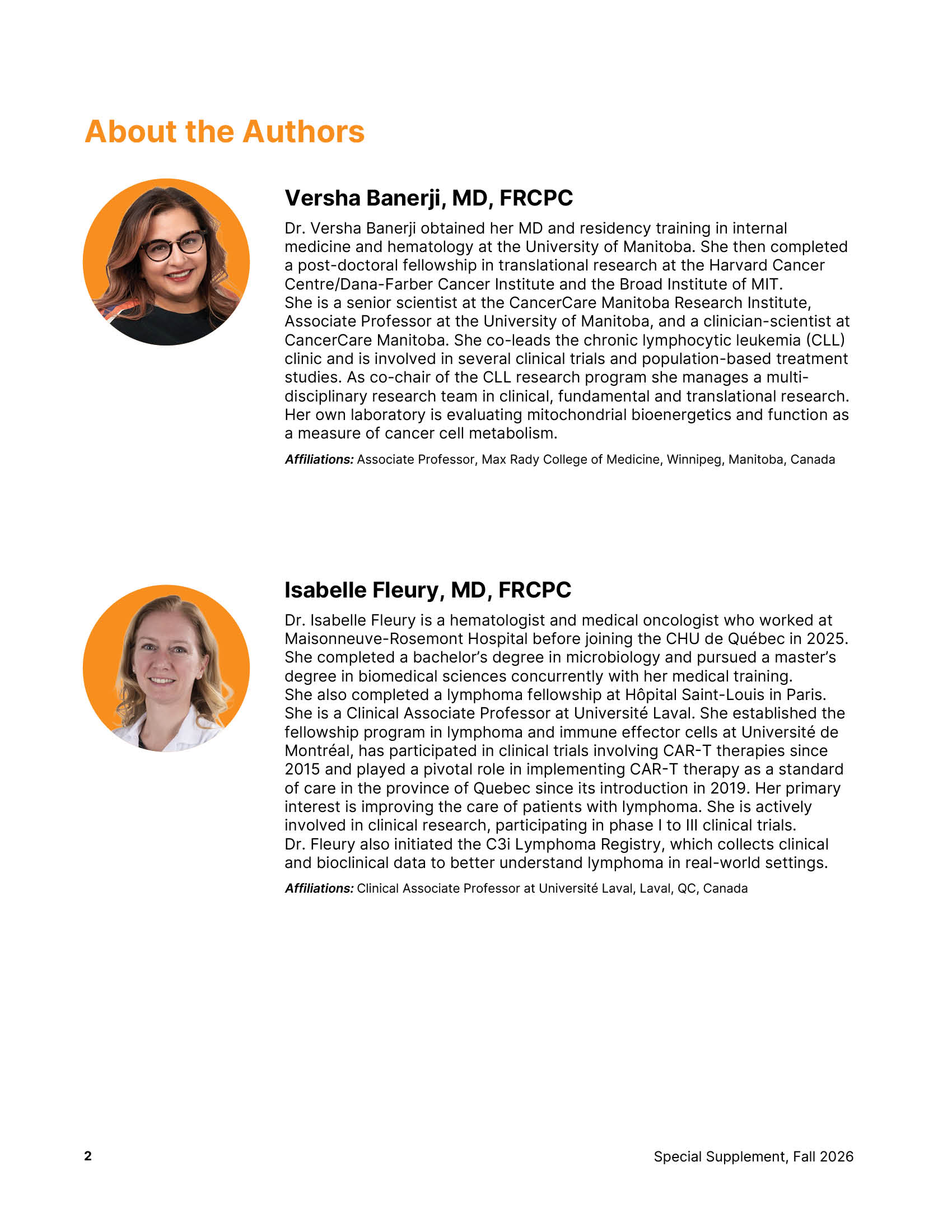
Versha Banerji

Dr. Versha Banerji obtained her MD and residency training in internal medicine and hematology at the University of Manitoba. She then completed a post-doctoral fellowship in translational research at the Harvard Cancer Centre/Dana-Farber Cancer Institute and the Broad Institute of MIT. She is a senior scientist at the CancerCare Manitoba Research Institute, Associate Professor at the University of Manitoba, and a clinician-scientist at CancerCare Manitoba. She co-leads the chronic lymphocytic leukemia (CLL) clinic and is involved in several clinical trials and population-based treatment studies. As co-chair of the CLL research program she manages a multi-disciplinary research team in clinical, fundamental and translational research. Her own laboratory is evaluating mitochondrial bioenergetics and function as a measure of cancer cell metabolism.

Isabelle Fleury

Dr. Isabelle Fleury is a hematologist and medical oncologist who worked at Maisonneuve-Rosemont Hospital before joining the CHU de Québec in 2025. She completed a bachelor’s degree in microbiology and pursued a master’s degree in biomedical sciences concurrently with her medical training. She also completed a lymphoma fellowship at Hôpital Saint-Louis in Paris. She is a Clinical Associate Professor at Université Laval. She established the fellowship program in lymphoma and immune effector cells at Université de Montréal, has participated in clinical trials involving CAR-T therapies since 2015 and played a pivotal role in implementing CAR-T therapy as a standard of care in the province of Quebec since its introduction in 2019. Her primary interest is improving the care of patients with lymphoma. She is actively involved in clinical research, participating in phase I to III clinical trials. Dr. Fleury also initiated the C3i Lymphoma Registry, which collects clinical and bioclinical data to better understand lymphoma in real-world settings.

Alina Gerrie

Dr. Alina Gerrie is a hematologist and Associate Professor in the Divisions of Medical Oncology and Hematology at the University of British Columbia (UBC) and a Clinician Investigator at the Centre for Lymphoid Cancer at BC Cancer, Vancouver Centre. She completed her medical degree and internal medicine residency at the University of Toronto, followed by hematology residency at UBC. She undertook a fellowship through the Royal College Clinical Investigator Program and earned a Master of Public Health degree from Harvard University, where her research included investigating the impact of genetic abnormalities on population-level outcomes in chronic lymphocytic leukemia (CLL) patients. Dr. Gerrie is a recipient of a Michael Smith Health Professional Investigator Award and is involved in translational, clinical trial, and outcomes-based research related to leukemia and lymphoma. Other academic interests include the investigation of novel therapeutics and cellular therapy for CLL and lymphoma.

Christopher Hillis

Dr. Chris Hillis is a hematologist specializing in hematologic malignancies at the Juravinski Cancer Centre and an Associate Professor at McMaster University. He is Vice President of Oncology at Hamilton Health Sciences, where he leads one of Ontario’s largest integrated cancer programs, and Regional Vice President for the Hamilton Niagara Haldimand Brant Regional Cancer Program with Ontario Health-Cancer Care Ontario. He previously served as Chief of Oncology and Associate Chief Medical Information Officer, and brings expertise in cancer system leadership, quality improvement, digital transformation and clinical operations, grounded in an MSc in Quality Improvement and Patient Safety and training as a U.S. Veterans Affairs Quality Scholar. A specialist in chronic lymphocytic leukemia and myeloproliferative neoplasms, he leads a Canadian Institutes of Health Research-funded research program focused on making clinical trial outcomes more meaningful to patients with hematologic malignancies. Nationally, he has served as President of the Canadian Hematology Society and held leadership roles with the Royal College and Choosing Wisely Canada.

Robert Puckrin

Dr. Robert Puckrin is a Hematologist and Clinician Investigator at the Arthur Child Comprehensive Cancer Centre and the University of Calgary in Calgary, Canada. His main interests are in lymphoma, stem cell transplantation, cellular therapies, bispecific antibodies, clinical trials, and real-world data.

Références

Téléchargements

Publié

2026-11-12

Comment citer

1.
Fixed-Duration First-Line Therapy for Chronic Lymphocytic Leukemia (CLL)/ Small Lymphocytic Lymphoma (SLL) in Canada: A Canadian Expert Clinical Framework. Can Hematol Today [Internet]. 12 nov. 2026 [cité 12 nov. 2026];5(s03):2-16. Disponible à: https://canadianhematologytoday.com/article/view/pdf.en

Numéro

Rubrique

Articles

Comment citer

1.
Fixed-Duration First-Line Therapy for Chronic Lymphocytic Leukemia (CLL)/ Small Lymphocytic Lymphoma (SLL) in Canada: A Canadian Expert Clinical Framework. Can Hematol Today [Internet]. 12 nov. 2026 [cité 12 nov. 2026];5(s03):2-16. Disponible à: https://canadianhematologytoday.com/article/view/pdf.en

Articles les plus lus du,de la,des même-s auteur-e-s